
Hear Us Out
There’s more to the story of data centers.
Data centers power the tools we use every day—and when they are done well, they can bring jobs, investment, stronger public services, and new opportunities to local communities.
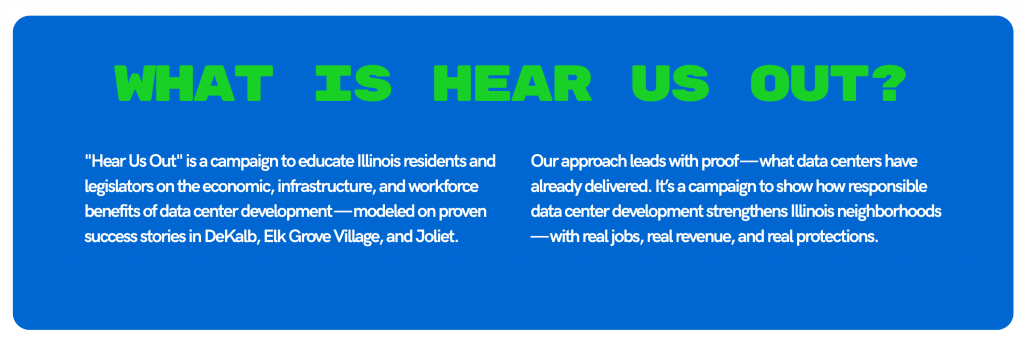
Hear Us Out is here to help individual residents and communities get a clearer picture of what data centers are, why they matter, and how communities across Illinois are already seeing real benefits from responsible development.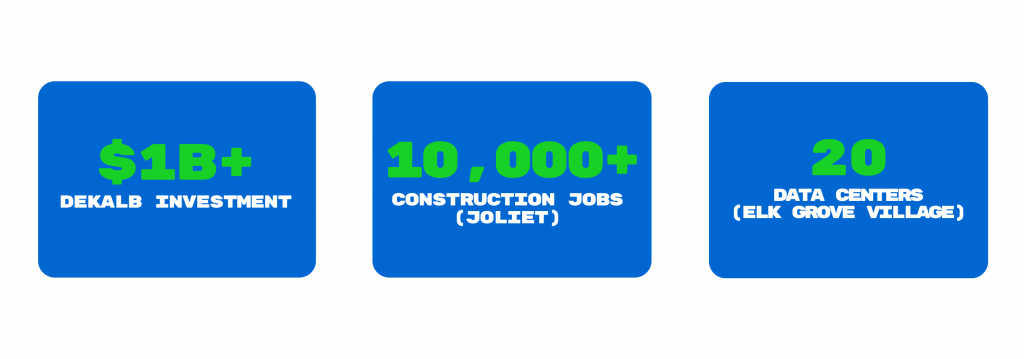
Why Data Centers Matter
Behind Everyday Technology Is Real Infrastructure
Every video call, online class, emergency alert, streaming service, banking app, healthcare system, and AI tool depends on digital infrastructure. Data centers are the facilities that make those services possible.
They may not always be visible, but they are part of the modern economy—and they are increasingly part of the communities where we live and work.
Positive Community Impact
When Done Right, Data Centers Can Strengthen Communities
Data centers can bring more than servers and buildings. Across Illinois, these projects have supported skilled construction jobs, created permanent positions, generated tax revenue, funded public services, and helped communities invest in schools, roads, sidewalks, parks, libraries, and local programs.
- Good construction jobs during major development phases
- Permanent skilled jobs in operations, maintenance, IT, HVAC, facilities, and security
- Local tax revenue that supports schools and public services
- Infrastructure improvements that benefit residents and businesses
- Community partnerships with schools, nonprofits, and local organizations
Real Illinois Examples
Communities Are Already Seeing Results
Elk Grove Village
Elk Grove Village is home to 20 operating data centers, helping make the community a major technology and industrial hub that have operated for more than 25 years. Data centers in Elk Grove Village have paid $45 million in property taxes. Revenue from these facilities supports schools, libraries, parks, and public services. Data Centers are part of the Villages efforts to support essential community services and have also enabled the Village to maintain the lowest property taxes, elminate residential vehicle stickers, and return $12 million to residents through water bill credits and more. Read the Elk Grove Village’s Special Edition Villager for more insight.
DeKalb
Meta’s DeKalb Data Center represents more than $1 billion in private investment and was built with a sustainable, LEED Gold-certified design. At peak construction, the project created approximately 1,200 skilled trade jobs and has provided more than $1.2 million in direct funding and grants to local schools and nonprofit organizations. DeKalb receives over $19 million dollars each year for its schools. A $34 million elementary school was funded and built with no taxes raises for residents. Now, a new $54 million early childhood development center is underway, with no cost to residents. A new firehouse was built in DeKalb, improving response times; and with the growth of the police department, crime is at an all-time low.
Joliet
The 795-acre Joliet Technology Center is expected to become the largest data center campus in Illinois. The multi-phase project is estimated to create between 7,000 and 10,000 construction jobs, approximately 700 permanent jobs once fully operational, and billions of dollars in tax revenue—including $100 million dedicated to city services, streets, and sidewalks.
Questions Are Fair
Communities Should Ask Questions—and Get Straight Answers
It is reasonable to ask how data centers affect energy use, water, jobs, infrastructure, and local services. Hear Us Out is designed to help residents look at the full picture: the benefits, the questions, and the facts behind both.
Common questions include:
What do data centers do? Data centers house the servers, networking equipment, cooling systems, and backup power that keep digital services running. They support everything from email and online banking to healthcare records, emergency communications, cloud storage, streaming, and AI tools.
How do they support the digital services we use every day? Every time someone joins a video call, streams a movie, checks a bank account, uses GPS, stores a file in the cloud, or receives an emergency alert, data has to be processed, stored, and moved securely. Data centers provide the physical infrastructure that makes those services fast, reliable, and available when people need them.
What kinds of jobs do they create? Data centers create significant construction work during development, including opportunities for skilled trades such as operating engineers, electricians, laborers, pipefitters, and other construction professionals. Once operational, they also support permanent jobs in facilities management, IT, security, maintenance, HVAC, electrical systems, and operations.
How can they support schools, public services, and infrastructure? Data centers can generate long-term local tax revenue that helps communities fund schools, public safety, roads, sidewalks, parks, libraries, and other public services. In some communities, operators have also supported local schools, nonprofits, workforce programs, and community organizations through grants and partnerships.
How are communities managing energy and water questions? Communities are asking important questions about power demand, grid reliability, cooling technology, water use, and sustainability. Many modern facilities are designed to improve efficiency, use advanced cooling systems, reduce water consumption, and work with utilities on long-term energy planning. The details vary by project, which is why local information and transparency matter.
What can residents learn from places like Elk Grove Village, DeKalb, and Joliet? These communities show that data centers can bring major investment, construction jobs, permanent positions, tax revenue, and direct community benefits. Elk Grove Village has seen revenue support public services and water bill credits. DeKalb has seen major private investment, skilled construction jobs, and grants for schools and nonprofits. Joliet is positioned for thousands of construction jobs, permanent employment, and major infrastructure funding.
Myth vs. Fact
Myth: Data centers do not create local value.
Fact: Data centers can generate major construction work, permanent skilled jobs, tax revenue, infrastructure investment, and community partnerships. The impact depends on the project, the location, and how the development is carried out.
Myth: Data centers are just buildings full of servers.
Fact: Data centers are part of the infrastructure behind online learning, healthcare systems, emergency communications, financial services, streaming, cloud storage, and AI. They support the digital tools people, businesses, schools, and communities use every day.
Call to Action
Hear the Whole Story
Data centers are already part of Illinois’ future. Before communities make up their minds, they deserve to hear more than one side of the story.